Fina Chat: the past, the current and the future


Fina Money has always been the most flexible finance tracker in the world.
Now, however, I would rather call it the most intelligent finance platform in the world.
AI has evolved so tremendously that it has vastly improved how we obtain and organize information. It is especially exciting when AI interacts with our personal data to create real upside!
In this post, I will walk you through a few examples to show you how AI has empowered Fina to become an incredibly useful tool for managing our finances.
Understanding the Past
Whether you are a paid-tier user with automated data or a free-tier user tracking manually, Fina keeps your financial activities organized, categorized, and tagged.
Because of this, a simple question can yield an accurate result displayed in your preferred visual format.
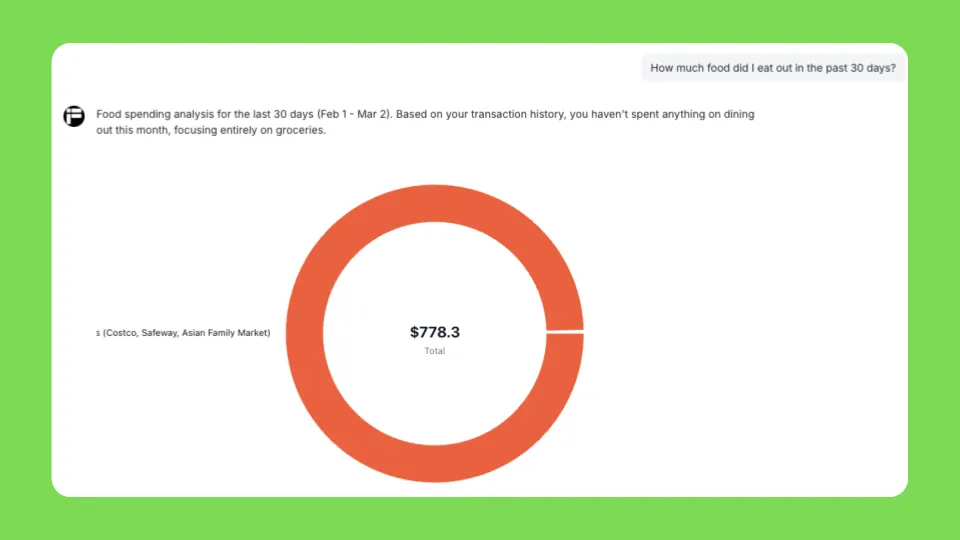
For example, if I ask, “How much did I spend eating out in the past 30 days?”, Fina will show me the answer:
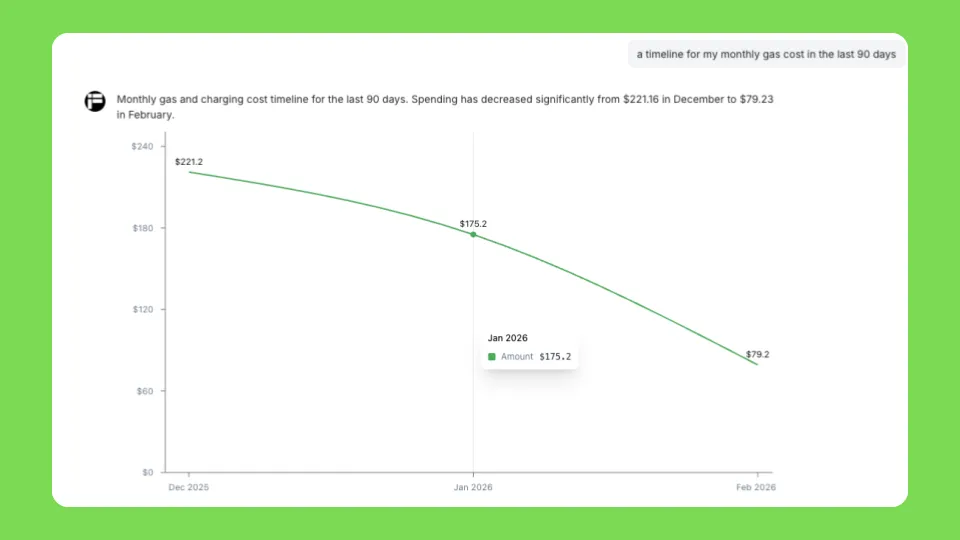
Or, I can ask for “a timeline for my monthly gas costs over the last 90 days”:
You can ask almost anything about your data, including questions that require complex calculations or formulas.
For instance, I can prompt Fina to: “Within the current profile, build a grid block to show my investment holdings with four metrics: cost, current value, gain or loss percentage, and % of total wealth. Sort the list by current value from high to low.”
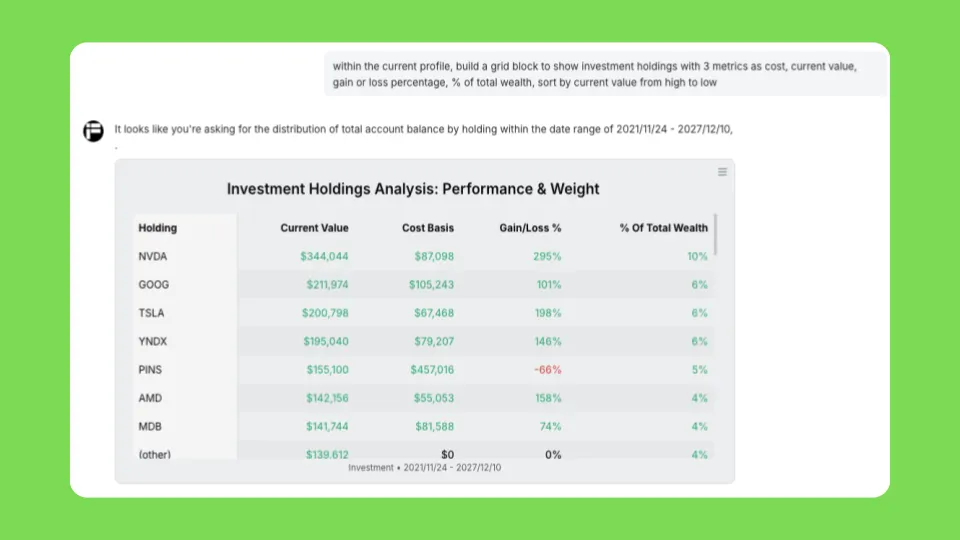
Even better, you can pin these blocks to your dashboard for real-time updates and future reference.
As you can see, Fina’s AI doesn’t just provide standard text answers; it builds savable computing models that update dynamically as your data changes.
Safety is also paramount. So, can it help detect suspicious transactions?
When I ask, “Can you review my transactions for fraud or suspicious activity?”, it successfully flags entries that look unusual (even if they turn out to be fine).
No screenshot here, :) I’ll leave testing that feature out as your homework!
Taking Action in the Present
Understanding the past gives us insights into our finances, but what can we do right now?
We can get recommendations and make adjustments to drive our finances into better shape.
Take credit card usage as an example: are we maximizing our benefits, or are there better choices we could be making?
To find out, I asked, “Am I getting all the value from my credit cards?” Fina clearly showed me how much of my spending utilized my highest reward tiers.
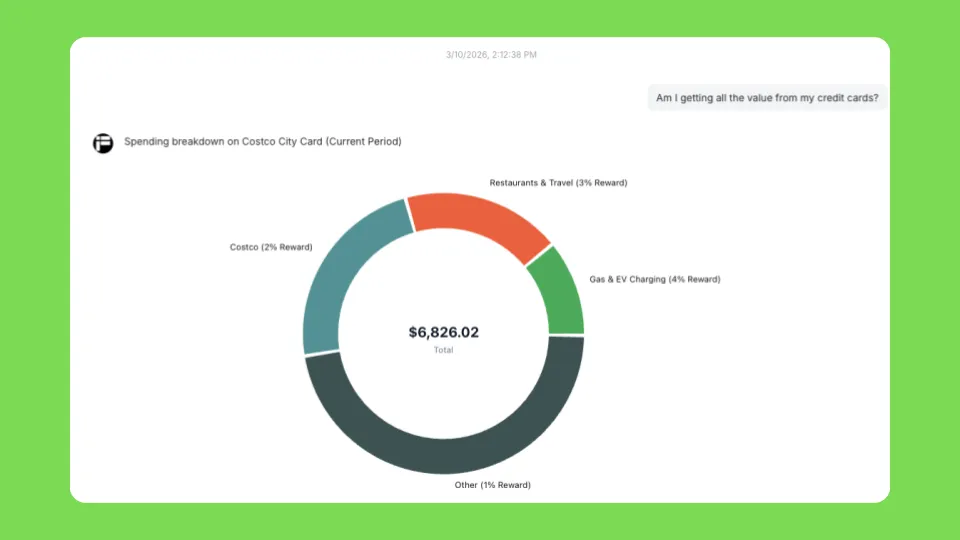
Looking at this, I realized I should probably use my Citi card more often for gas and EV charging.
This led me to wonder: could I apply for credit cards that offer better returns based on my past spending patterns?
So I decided to ask: “Recommend the best credit cards for me based on my expenses last year.”
Wow, it gave me some fantastic choices!
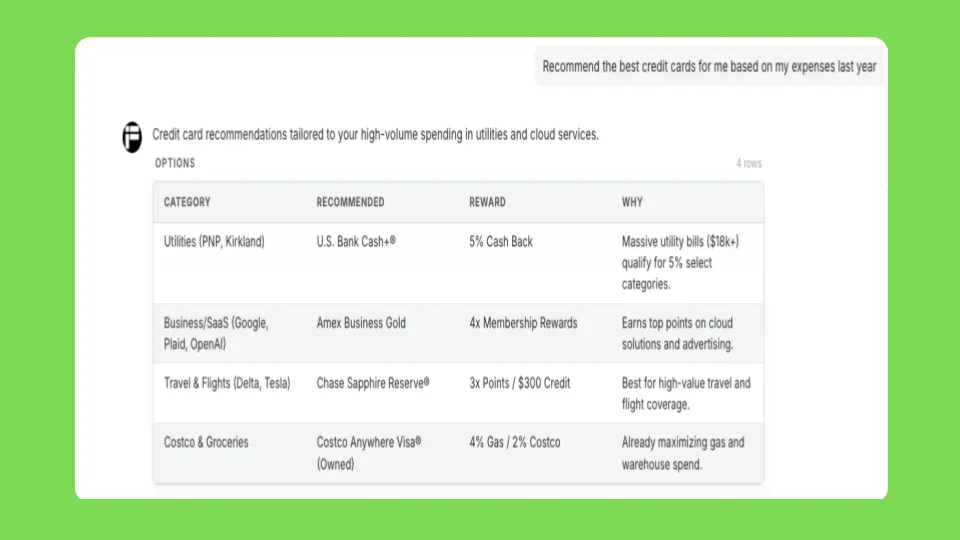
If you ever need personalized suggestions for your own situation, all you have to do is ask!
Foreseeing the Future
Having a crystal ball to look into the future would be amazing.
While that doesn’t exist in reality, we can still paint an estimated picture of the future based on past experiences. This is where projecting your finances becomes really interesting.
One of the most fun things to forecast is how much wealth you will have in ten years. Monte Carlo simulations are widely used for this exact purpose, so let’s run an example to see how it feels.
I asked: “Based on my current stock holdings, can you run a Monte Carlo simulation to project how much total wealth I will have in 10 years? Show me the annual numbers in all variances, year by year.”
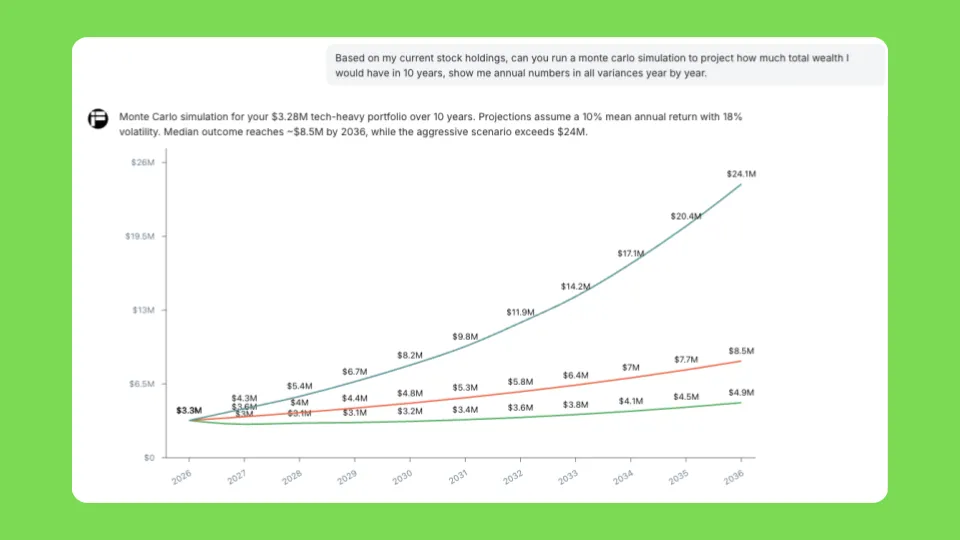
The initial aggressive variance seemed a bit too good to be true, probably a return even a genius investor couldn’t guarantee!
So, I decided to ask it to use more realistic bounds for the simulation: “How about using S&P 500 data from the past 5 years to set the bounds for all variances and run the simulation again?”
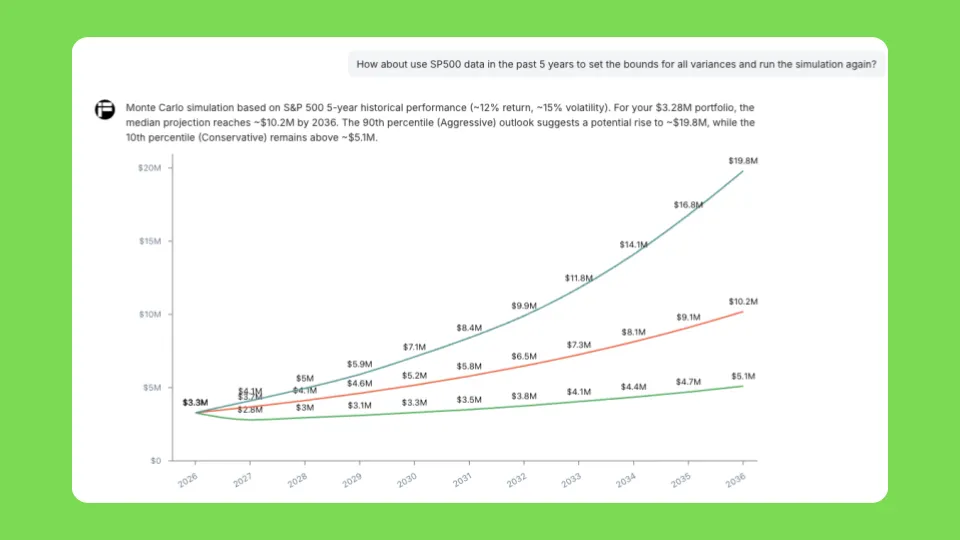
I didn’t just want a simple projection from a starting balance; I also wanted to include future life events in the simulation.
And yes, Fina handled it perfectly. I prompted: “I plan to withdraw $50K annually from Year 3 to Year 6 for education costs. Can you factor this in and run the projection again?”
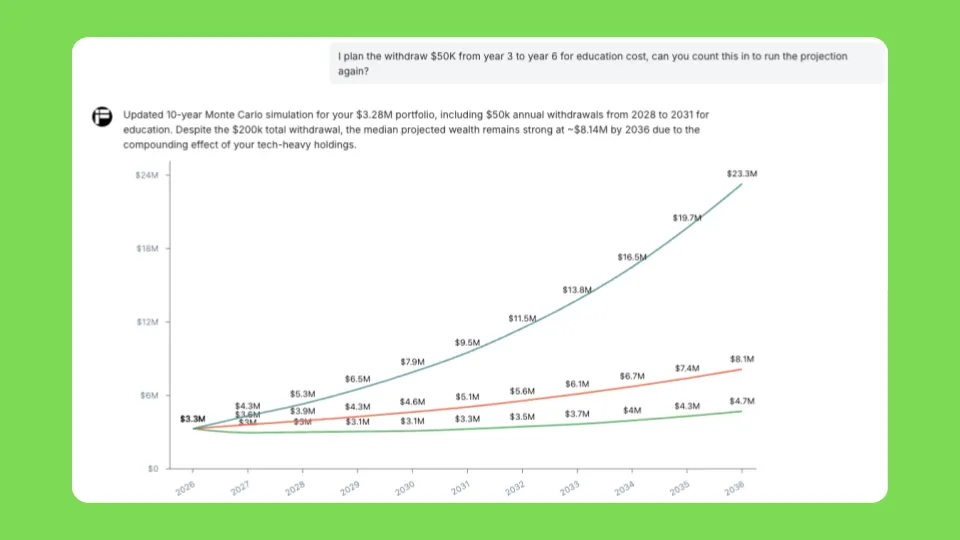
As expected, this life event slowed down the growth curve, but not by too much. It still looks safe and on track to me.
Conclusion
I am incredibly excited about this 360-degree method of looking at personal finances.
It simply helps us build a well-rounded financial picture by:
- Understanding the past.
- Taking action in the present.
- Foreseeing the possible future.
If you are as excited about these capabilities as I am, try out Fina Chat now!